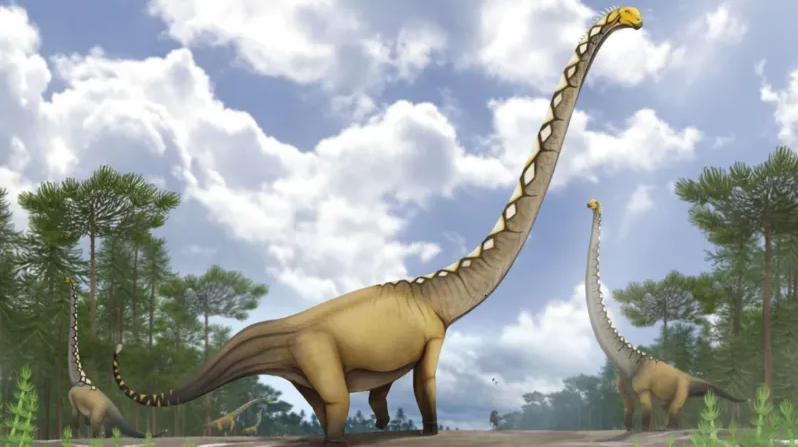
Scientists in Thailand have announced the discovery of a previously unknown dinosaur species that roamed the Earth approximately 150 million years ago during the Late Jurassic Period. The remarkable discovery provides new insights into prehistoric life in Southeast Asia and highlights Thailand's growing importance in dinosaur research.
Named Uragasaurus kalasinensis, the newly identified dinosaur belonged to a family of enormous long-necked plant-eating dinosaurs known as Mamenchisauridae.
A Giant Herbivore from the Jurassic Era
Researchers estimate that Uragasaurus kalasinensis measured around 20 meters (66 feet) in length, making it roughly as long as a standard cricket pitch. Like other sauropods, it survived on vegetation and used its exceptionally long neck to reach plants growing at various heights.
This dinosaur was a peaceful herbivore that likely lived alongside many other prehistoric animals in what is now northeastern Thailand.
Discovery Began with a Chance Fossil Find
The fossils were recovered from the Phu Noi fossil site in Kalasin Province, northeastern Thailand.
Interestingly, the discovery traces back to 2008, when a local resident found unusual fossil fragments that resembled serpent scales. This prompted paleontologists to investigate the area, eventually uncovering one of Thailand's richest dinosaur fossil sites.
Since then, researchers have excavated thousands of fossils from the region, with more than 90 percent belonging to dinosaurs.
The Fossil That Changed Everything
The breakthrough came after scientists examined a dorsal vertebra, a bone from the middle section of the dinosaur's back.
Using advanced CT scanning technology, researchers discovered that the vertebra possessed several distinctive anatomical features that had never been documented before.
Among the most remarkable characteristics were:
- A unique Y-shaped arrangement of supporting bones known as laminae.
- An unusual internal air-cavity structure.
- Skeletal features unlike those of any previously identified dinosaur.
These unique traits confirmed that the fossil represented an entirely new dinosaur species.
First Mamenchisauridae Dinosaur Found in Thailand
Although members of the Mamenchisauridae family have been discovered mainly in China, Uragasaurus kalasinensis is the first confirmed member of this group found in Thailand.
This discovery expands scientists' understanding of how these giant long-necked dinosaurs spread across ancient Asia millions of years ago.
Rich Fossil Site Continues to Surprise Scientists
The Phu Noi excavation site has become one of Southeast Asia's most important paleontological locations.
Researchers have recovered:
- Dinosaur teeth
- Vertebrae
- Limb bones
- Various skeletal fragments
- Fossils from multiple prehistoric species
Each new excavation continues to improve scientists' knowledge of the region's ancient ecosystems.
Another Giant Dinosaur Was Recently Identified
This is not the only exciting dinosaur discovery from Thailand.
Earlier this year, scientists also identified Nagatitan, another enormous long-necked herbivorous dinosaur. Measuring approximately 27 meters (88 feet) in length and weighing nearly 27 tonnes, Nagatitan is currently regarded as the largest dinosaur ever discovered in Southeast Asia.
These findings suggest that Thailand was once home to an impressive diversity of giant sauropods during the Jurassic period.
Why This Discovery Matters
The identification of Uragasaurus kalasinensis demonstrates that Southeast Asia still holds enormous scientific potential for uncovering previously unknown prehistoric species.
As fossil exploration continues across Thailand, researchers believe additional discoveries could reshape our understanding of dinosaur evolution, migration, and biodiversity during the Jurassic era.
Key Facts at a Glance
| Feature | Details |
|---|---|
| Dinosaur Name | Uragasaurus kalasinensis |
| Dinosaur Type | Sauropod (Plant-Eating) |
| Family | Mamenchisauridae |
| Age | Around 150 million years |
| Geological Period | Late Jurassic |
| Estimated Length | Approximately 20 meters (66 feet) |
| Discovery Location | Phu Noi, Kalasin Province, Thailand |
| Identification Method | Fossil analysis and CT scanning |
| Importance | First Mamenchisauridae discovered in Thailand |
Final Thoughts
The discovery of Uragasaurus kalasinensis marks another major milestone in dinosaur research and reinforces Thailand's reputation as an important region for paleontological exploration. With its extraordinary size, unique skeletal anatomy, and scientific significance, this Jurassic giant adds a fascinating new chapter to Earth's prehistoric history.
As researchers continue studying Thailand's fossil-rich landscapes, even more groundbreaking discoveries may still be waiting beneath the surface.
FAQ
When did Uragasaurus kalasinensis live?
Scientists estimate it lived approximately 150 million years ago during the Late Jurassic Period.
How large was the dinosaur?
The dinosaur measured about 20 meters (66 feet) in length.
What did it eat?
It was a plant-eating sauropod, feeding on vegetation using its exceptionally long neck.
Where was it discovered?
The fossils were uncovered at the Phu Noi fossil site in Kalasin Province, northeastern Thailand.
Why is the discovery important?
It represents the first confirmed Mamenchisauridae dinosaur discovered in Thailand, expanding knowledge of dinosaur distribution across ancient Asia.